
This is not a post so much as a proposal to begin the long-needed effort to catalogue the real photo postcard backs used in Canada. While most “Canadian” postcard blanks were manufactured by U.S. manufacturers, their inscriptions were often modified to suit Canadian tastes and postal regulations. Today, most people rely on Playle’s, a U.S. site, for information about dating RPPCs without recognizing that what that (excellent) site says might not apply to Canada. Also, it is much more useful to catalogue the entire back rather than just the stamp box — as Playle’s does –, since backs often differ even when the stamp box doesn’t (not to mention that the stamp box on many cards is covered up with a stamp).
With this in mind, and as a starting-point and/or place-holder, I’m uploading a Word copy (link below) of a classification system that I’ve used in cataloguing RPPCs from one company, the Winnipeg Photo Co. of Napinka, Manitoba, which produced RPPCs across southern Manitoba and Saskatchewan (as well as Alberta’s “Western Canada Ranching Series”) under a number of names from about 1905-1912. There are many other backs, of course, but this is at least a beginning.
My medium-term intention is to turn this lowly blog post into a page on the TPC website, complete with illustrations of the back types. But for the moment, this will need to do (and may generate some discussion).
WPC Appendix – Postcard Backs (classification scheme)
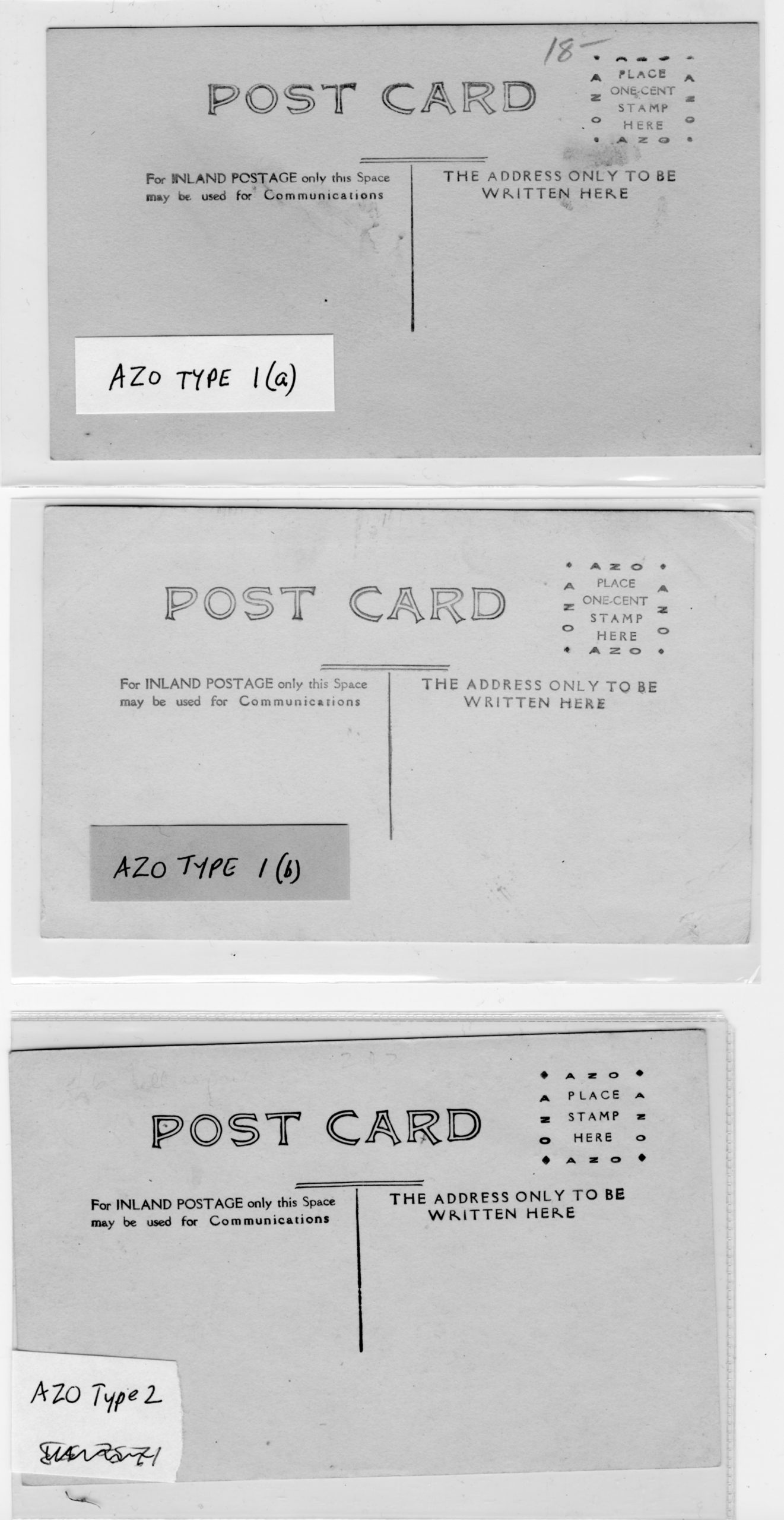
Below are examples of AZO backs 1(a), 1(b) and 2, from the attached. — Andrew Cunningham
I have drafted a written summary of my findings. Would you consider reviewing it? I have never written for CardTalk etc but would like to start. Thanks.
Sure, send it to me anytime. There isn’t another Card Talk until April (“Winter” is going to press this coming week), so no hurry.
I am struggling with RPPC backs as well. I have found and labeled six Kodak AZO backs to date.
AZO1a -4 upright triangles (1904-1918) [8 cards]
AZO1b -as above with the addition of “Made in Canada” (1904-1918)
The difference in backs would only be useful if the dates of design change were known [2 cards]
AZO2- 4 diamonds, no “Made in Canada” and with the addition of a double line header and “For INLAND POSTAGE only this Space may not be used for Correspondence” left of the middle header and “THE ADDRESS ONLY TO BE WRITTEN HERE” on the right side. (1905-1908) [4 cards]
AZO3- 4 dots but otherwise the back is the same as AZO2 [34 cards]
AZO4- 4 squares and now no middle vertical line but otherwise the same as back AZO1a and b (1924-1949) [5 cards]
AZO5-4 arrowheads, otherwise the same as back AZO4 (1945-1949} [3 cards]
Hi, It would definitely be nice to get a handle on this issue! A guide to dating the cards would be very useful. As you are doing (but even more so, perhaps) I tend to look at the entire back and not so exclusively at the stamp box (Playle’s “stamp box” website seems to have encouraged this inadvertently). One obvious reason for looking at the backs more holistically is that the stamp box is often obscured by a stamp! So a dating protocol based on stamp box features alone is going to be of little use for many cards.
I made a very preliminary stab at this topic in an article in Cardtalk 141 (Fall 2023). There I looked only at the AZO backs with the “For Inland Postage Only” inscription, which I called “FIPO Backs”. There were many varieties of FIPOs, which as a group seemed (based on my sample of 100) to have been sold in the years 1906-1910 (given their rapidly declining use thereafter). I didn’t get far enough to draw many conclusions, other than that the oldest examples appear to be a design in which the “R” in “CARD” has a very long extender (i.e. down and to the right). That design appeared in 1906 (it seems) in relatively small numbers before the avalanche of other kinds of AZO RPPCs (i.e. that don’t have the “long” R) began to appear in 1907 (or perhaps late 1906). There are many variations in those 1907-10 AZO FIPO designs.
I didn’t look at the “MADE IN CANADA” (MIC) variety then, but I know they are the later cards (the cards’ producers seem to have progressively reduced the quantity of text on their RPPC backs). I don’t believe the MIC cards appeared until closer to the First World War – they’re generally either “war years” cards or later (sometimes much later) than that. It would require an examination of a lot of examples to figure out how to distinguish all the MIC varieties (likely stamp box arrows or other small details in the wording and dividing lines).
Hope this helps and glad to discuss,
Andrew Cunningham
Thanks for the reply. I think Playle is right myself. I have found only one stamp box that has two separate card back designs. The design of the other backs is consistent with the stamp box design. In that way it should be able to determine the stamp box design when covered by the upper half of the card back alone. That will fail only if cards are found with the same design but different stamp boxes. None so far.
I will now consider the extended R design to see where it leads me.
I have now found 7 AZO stamp box designs with one further having a local printer add its trademark to the back after purchase. Not sure this counts.
I have found 6 CYKO stamp box designs, 2 NOKO designs, 1 Solid, 2 VELUX and 1 unknown back.
Glad to keep discussing
Interesting. I’m not sure if I found cases where there wasn’t a 1:1 match between stamp box and overall back design. I will look out for that. I found some of the cards I’d assembled for that article. There were quite a few of the “long R” variety, earliest postmark I noted was p/m MAR 9 06. The vast majority of those that I found were posted between spring and fall 1906. But, on closer inspection, most of those seem to be CYKO backs, with a CYKO stamp box (this back is nearly but not quite identical to what Bogdan & Weseloh call the “Cyko 4” back in their Real Photo Postcard Guide (if you have that)). These have only the words “THIS SIDE FOR THE ADDRESS” beneath the words “POST CARD”. CYKO, according to Bogdan & Weseloh, was *not* a Kodak brand. Whether this back was prepared for Canada or just a U.S import I’m not sure. Probably the latter.
However, to complicate matters still further, a few of my “long R” backs have divided FIPO backs that are definitely Canadian (I’m pretty sure that FIPO was exclusively Canadian wording). The earliest of these is p/m JUL 30 1906. The 2 of these long-R FIPOs that I have in front of me are stamped, but it looks to me that they might not have stamp boxes at all, so it will be hard to tell who made them. Bogdan & Weseloh show Velox (Kodak brand) issuing a “long R” card in the U.S. as early as summer 1905 (again, with “THIS SIDE FOR THE ADDRESS” as the inscription), but none of their AZO examples have the “long R”. All very confusing!!!
I believe AZO offered to print the local photographer’s name up the left-hand side of the back of their cards, as this is commonly seen on the cards of certain big producers of RPPCs. Not sure if that is what you meant by trademark – I don’t believe I’ve seen any symbols added by/for a local photographer, although it sounds like something that would have been done now and then.
Hope this helps rather than muddying the waters even more…
Every time I think about their classification, I have to take a step back to look at the forest again.
At 10,000 feet it seems to me that there are 4 basic AZO card designs. I do not list them chronological order for now. I start with the simplest design.
MIC-“MADE IN CANADA”
FIPO- “for INLAND POSTAGE ONLY”
NEW-neither MIC or FIPO
1. MIC card with no vertical dividing line; (4 squares and 4 arrowheads)
2. MIC card with a vertical dividing line; (4 upright triangles)
3. NEW card with no MIC or FIPO with a vertical dividing line; (2 upright at top/2 downward triangles at bottom)
4. FIPO card with extended R in “card”, a vertical dividing line and a double line at the top of the dividing line extending only such that it is almost, but not quite, overtop of the THE on the address side of the card. (4 diamonds)
5. FIPO card with all the same feature but the horizontal line now completely covers the “THE” on the address side of the card. (4 dots).
I believe your 1(a) back is 4 dots not diamonds. Your 1(b) is 4 diamonds and the same as card #2.
Shall we move on to CYKO or is this discussion still alive?
Good summary. In looking at “FIPO” backs, I wasn’t focusing on AZO exclusively, but if we did focus on AZO it could definitely be the case that the number of designs turns out to be relatively small. The other Kodak brands (Velox and Solio, which I was also looking at, at the same time) have very similar FIPO inscriptions, but with quite a few additional variations in the lettering and dividing lines, etc. That’s where I was getting the idea that the number of variants of this type of back (i.e. the FIPO back, irrespective of brand) is large.
The many “golden age” RPPC brands were often promoted as having special photographic properties, but I’m not sure if that sort of thing was the basis for Kodak’s distinction between AZO, Velox and Solio, or if (in the alternative) those brands were regional in the U.S. Or perhaps it was simply that they came from different factories – Velox, I recollect, was an independent company that Kodak acquired around the turn of the century, to get its hands on their photo-paper IP.
Anyway, all that said, two other differences that I note in my AZO-branded cards are:
1. many AZO FIPO cards have two extra-wide “R”s in the inscription “THE ADDRESS ONLY TO BE WRITTEN HERE”. Others have narrower “R”s. Cards of these two types generally seem to be virtually identical otherwise.
2. the stamp box on AZO FIPO cards usually reads “PLACE ONE-CENT STAMP HERE” but can also read “PLACE STAMP HERE”.
Certainly glad to look at Cyko too, which in my collection are a little less common and which I don’t associate with as much variety as the Kodak brands (AZO, Velox, Solio etc.). Maybe I’m wrong though.